Moruya
No red dust, no brown snakes, no crocodiles. This is way too civilised. We are sitting in our dinky little cabin on the banks of the tranquil Araluen River at Moruya. In front of us are two families with little kids fishing and the Dads being knowledgeable about bait and casting. They’d better be happy with hamburgers for dinner, though, because there aren’t any fish being caught.
But it’s a lovely scene, big old palm trees on the river bank, and now, after an hour or so of wind and thunder, the patter of rain.
We filled the D4 (that’s Land Rover talk for Discovery 4) up to the gills with boxes of stuff, laughing about the fact that the last trip we had we went across three countries with one tiny backpack each. But for that trip we didn’t need a frying pan, a winch, a personal locator beacon. Although, come to think of it, there were a couple of times when they would have come in handy. A winch up the Grand St Bernard Pass would have been just dandy, and as for when we got lost in the forest...
The drive down the South Coast is very beautiful in a green hills, brown cows and blue ocean sort of way. And the forests lining stretches of the road are really lovely, tall slender stands of eucalypts. Kangaroo Valley, Kiama, Mollymook, the names just speak holidays and relaxation.
But here we are, fired up and ready to go, tomorrow we pick up our camper trailer (waiting list 6 months) and learn how to use it. Then the next day, head off to the North West. We did spear off into the forest for lunch, just to get into the spirit of it, and tonight we are cooking our food out of the supplies crate, to ease ourselves into the really simple life.
Just one little thing is exercising our mind: this rain now falling has also been falling in big lumps all over the area we are planning to cross, out in the backblocks of Queensland. That lovely wild back country, all dry and arid is now full of wildflowers and it just keeps raining. There are roads cut everywhere. Tomorrow we will consult the Bureau of Meteorology and see where we can go. I’ll keep you posted, as they say. If you hear a gurgling noise, send out a rescue team.
Sunday, March 13, 2011

Saturday, March 12, 2011


Sunday, November 28, 2010
Arrividerci Roma
24.11.10 – 28.11.10

It’s everywhere in Rome. L’Amore. Couples kissing in every corner and archway. Maybe it is the result of all the flesh on display in marble, everywhere. The ancient Romans mostly laid a tasteful thin layer of cloth across the gentle undulations of the human form, or a fig leaf, but truly, it got completely out of hand later and it’s all there is 3D. And they are all so perfectly slim, trim, perky, or cut. Talk about abs! You were never going to get immortalised if you were too keen on dessert.
We have a feast of all that, and all the art you could poke a paintbrush at, today. It is Villa Borghese day, the massive park with a stately pile in the centre and several other generous sized buildings scattered around the grounds, all now owned by the state.
Scipione, the Pope’s nephew (and, flaunting something I just learned, did you know that nepotism comes from the word for nephew because the Pope traditionally gave the equivalent role of Secretary of State to his nephew). Where was I? Oh yes, the Pope’s nephew was put in charge of his collection and he got all the guys on to painting, sculpting and generally making the Villa Borghese and its collection an outstanding place for us to pop along and fill in a lazy half day in 2010. Thanks, mate, excellent.
It’s in a huge park that must be a real oasis in the heat of summer, but, oh, the building and its statues and paintings! Enough said. We’ve learned a lot about Raphael and there are plenty to see here, including his self-portraits and the statue of David with Raphael’s own face. And with a slingshot. He could have sorted out some of those damned dogs we met along the way. The Bernini statues, oh so exquisite, so fine, how on earth do you carve marble so that you can see the press of fingers in flesh? And there is a delightful statue of Pauline Borghese, Napoleon’s sister, I can’t remember by whom, reclining on a divan. Oops, careless girl, she’s mislaid her top.
I follow this high culture with a haircut. There is a hairdresser opposite our apartment and I take pot luck. What fun, he comes from a career in the movies, is married to a Danish woman and had Queen Margarethe as a client, among many other famous people. Now in later life he just wants to enjoy quiet life as a solo hair artiste. Jacques Fontaine, and the photos on the walls all tell a story about someone or other. It should have taken an hour or so but I’m there for two hours as he leans on his comb and we rabbit on.
Then as evening falls we wander down to the Trevi Fountain again and stand transfixed by it lit at night. I stand there staring at it and thinking, “ I don’t know if I can go home and not see this again.” Nothing like being a tourist to give you a good appetite, though, and it’s pasta time. We’re eating our cannelloni, a stooped old man comes in and plays a lute, then goes between the tables collecting tips. The staff is chatting, the girl on the cash register is singing to herself, it’s getting late. Another lovely day in Rome. I really like this city.
Next day we’re off to the Pantheon. It sounds like it’s worth a look, but the real drawcard is that Raphael’s tomb is in there and I just have to see it. What’s this, a piazza we passed on our first day and liked, but now we know what we’re looking at and that just has to be a Bernini fountain, two actually. We consult the guidebook. Yes! That was one busy boy, and handy with a hatchet and a block of stone. Three laps around the square, stopping every two metres to exclaim some more, and another bookfull of photos, and we head for the Pantheon. Raphael’s tomb, and it’s beautiful inscription, I can’t recall the exact wording but it was along the lines of “When he lived, Nature was afraid that he would outdo her, and when he died, she was afraid everything would die with him. “ I had a moment, one of the highlights, pass a tissue.
Then out again, have I mentioned that the weather has been a bit iffy? Apparently there has been no rain for 6 months, it was all saved up for our week in Rome. So we walk out into the square outside the Pantheon; it is getting set for a major Bolsena and there is a freezing wind whipping up. We take the easy way out and scuttle back to our warm dry apartment.
R is on strike. He will not step into another church. I remind him that half the art in Italy is to be found right on the walls inside churches. It makes no difference, he has reached the plimsoll line and the sight of another altar is going to sink the ship. So I say, “No problem, you go and find a bar, but there are just a couple of churches I need to visit while we’re here. “ No, he’ll come with me just to keep me company and wait outside. But it’s no good, the first one, Santa Maria Maggiore has Bernini’s tomb inside, I have to see that, and he can’t resist either. Then the next, St Peter in Chains, has the Michelangelo Moses, so there we are both inside with the camera going. (St Peter in Chains is named that because, get ready, there are the actual chains that bound St Peter as a relic in a glass case.)
The Princess Eudoxia was given them by her Empress mother who received them from the hand of the Bishop of Jerusalem himself, so they are obviously the real deal, and very dramatic they look, draped tastefully and well lit for the faithful. And Eudoxia built the church especially to house them. Actually there is another church that goes one better, having the actual heads of both St Peter and St Paul in silver boxes. Another has the finger of St Thomas, and there are enough bits of the true cross here and there to build a house. However after St Peter in Chains I can see that we have finished with churches.
I have, however, not quite seen enough of the crew of painters who I have come to feel quite attached to, meeting them all along the way. They did get around, these boys. Something very fascinating has struck me. I bought an historical novel about the Wars of the Roses in England and realised with a start that it was the same time, roughly speaking, as all of these new favourite artists. So I did a chronology of them and cross- referenced them with the battles of the Wars of the Roses. I clearly have too much time on my hands and need to come home and get back to work.
Just a couple of Palazzos before I do… I did want to see how the rich and famous lived, not turned into a gallery, but sort of how they lived in real life. And I strike gold in the final place we visit in Rome, a palace with the family rooms on display, Palazzo Doria Pamphili. The family portraits are on on the walls, the furniture is in the rooms, and there is a massive collection of personally collected and owned art on every square centimetre of wall, but, most interesting of all, it is a palazzo where the family still lives. It is gorgeous, lush, magnificent, beautiful. The audio guide is narrated by the son of the current Princess, welcoming us to his home, and explaining that in the early 1800s the first English wife married into the family, several more have followed and the family is all educated in England and speaks more English in the family than Italian. (I wonder if he says that in the Italian version). But the portrait of that first English wife, Mary Talbot, is on the wall, and the guide explains that (get your hanky ready) when she died, her husband, devastated by grief, retired to his country villa and had a box hedge planted that was trimmed to say her name; it was placed so that it was the first thing he saw in the morning every day when he looked out of his window.
I can’t tear myself away, even looking at the highlights in each room has taken a couple of hours. R leaves for a while, comes back, then fainting with hunger and gallery fatigue, suggests that we have given it a good crack and it’s time for lunch.
Good suggestion. After all, Italy is as much about food as art. We have done well with both over the last two months. Italy is a great country, with a fabulous legacy of beauty from its artists, and with sensational scenery. It seems like a long time since we stepped out onto the road at Besancon and started to put one foot in front of another, walking through three countries on our way to Rome. Now it’s time to leave.


It’s everywhere in Rome. L’Amore. Couples kissing in every corner and archway. Maybe it is the result of all the flesh on display in marble, everywhere. The ancient Romans mostly laid a tasteful thin layer of cloth across the gentle undulations of the human form, or a fig leaf, but truly, it got completely out of hand later and it’s all there is 3D. And they are all so perfectly slim, trim, perky, or cut. Talk about abs! You were never going to get immortalised if you were too keen on dessert.
We have a feast of all that, and all the art you could poke a paintbrush at, today. It is Villa Borghese day, the massive park with a stately pile in the centre and several other generous sized buildings scattered around the grounds, all now owned by the state.
Scipione, the Pope’s nephew (and, flaunting something I just learned, did you know that nepotism comes from the word for nephew because the Pope traditionally gave the equivalent role of Secretary of State to his nephew). Where was I? Oh yes, the Pope’s nephew was put in charge of his collection and he got all the guys on to painting, sculpting and generally making the Villa Borghese and its collection an outstanding place for us to pop along and fill in a lazy half day in 2010. Thanks, mate, excellent.
It’s in a huge park that must be a real oasis in the heat of summer, but, oh, the building and its statues and paintings! Enough said. We’ve learned a lot about Raphael and there are plenty to see here, including his self-portraits and the statue of David with Raphael’s own face. And with a slingshot. He could have sorted out some of those damned dogs we met along the way. The Bernini statues, oh so exquisite, so fine, how on earth do you carve marble so that you can see the press of fingers in flesh? And there is a delightful statue of Pauline Borghese, Napoleon’s sister, I can’t remember by whom, reclining on a divan. Oops, careless girl, she’s mislaid her top.
I follow this high culture with a haircut. There is a hairdresser opposite our apartment and I take pot luck. What fun, he comes from a career in the movies, is married to a Danish woman and had Queen Margarethe as a client, among many other famous people. Now in later life he just wants to enjoy quiet life as a solo hair artiste. Jacques Fontaine, and the photos on the walls all tell a story about someone or other. It should have taken an hour or so but I’m there for two hours as he leans on his comb and we rabbit on.
Then as evening falls we wander down to the Trevi Fountain again and stand transfixed by it lit at night. I stand there staring at it and thinking, “ I don’t know if I can go home and not see this again.” Nothing like being a tourist to give you a good appetite, though, and it’s pasta time. We’re eating our cannelloni, a stooped old man comes in and plays a lute, then goes between the tables collecting tips. The staff is chatting, the girl on the cash register is singing to herself, it’s getting late. Another lovely day in Rome. I really like this city.
Next day we’re off to the Pantheon. It sounds like it’s worth a look, but the real drawcard is that Raphael’s tomb is in there and I just have to see it. What’s this, a piazza we passed on our first day and liked, but now we know what we’re looking at and that just has to be a Bernini fountain, two actually. We consult the guidebook. Yes! That was one busy boy, and handy with a hatchet and a block of stone. Three laps around the square, stopping every two metres to exclaim some more, and another bookfull of photos, and we head for the Pantheon. Raphael’s tomb, and it’s beautiful inscription, I can’t recall the exact wording but it was along the lines of “When he lived, Nature was afraid that he would outdo her, and when he died, she was afraid everything would die with him. “ I had a moment, one of the highlights, pass a tissue.
Then out again, have I mentioned that the weather has been a bit iffy? Apparently there has been no rain for 6 months, it was all saved up for our week in Rome. So we walk out into the square outside the Pantheon; it is getting set for a major Bolsena and there is a freezing wind whipping up. We take the easy way out and scuttle back to our warm dry apartment.
R is on strike. He will not step into another church. I remind him that half the art in Italy is to be found right on the walls inside churches. It makes no difference, he has reached the plimsoll line and the sight of another altar is going to sink the ship. So I say, “No problem, you go and find a bar, but there are just a couple of churches I need to visit while we’re here. “ No, he’ll come with me just to keep me company and wait outside. But it’s no good, the first one, Santa Maria Maggiore has Bernini’s tomb inside, I have to see that, and he can’t resist either. Then the next, St Peter in Chains, has the Michelangelo Moses, so there we are both inside with the camera going. (St Peter in Chains is named that because, get ready, there are the actual chains that bound St Peter as a relic in a glass case.)
The Princess Eudoxia was given them by her Empress mother who received them from the hand of the Bishop of Jerusalem himself, so they are obviously the real deal, and very dramatic they look, draped tastefully and well lit for the faithful. And Eudoxia built the church especially to house them. Actually there is another church that goes one better, having the actual heads of both St Peter and St Paul in silver boxes. Another has the finger of St Thomas, and there are enough bits of the true cross here and there to build a house. However after St Peter in Chains I can see that we have finished with churches.
I have, however, not quite seen enough of the crew of painters who I have come to feel quite attached to, meeting them all along the way. They did get around, these boys. Something very fascinating has struck me. I bought an historical novel about the Wars of the Roses in England and realised with a start that it was the same time, roughly speaking, as all of these new favourite artists. So I did a chronology of them and cross- referenced them with the battles of the Wars of the Roses. I clearly have too much time on my hands and need to come home and get back to work.
Just a couple of Palazzos before I do… I did want to see how the rich and famous lived, not turned into a gallery, but sort of how they lived in real life. And I strike gold in the final place we visit in Rome, a palace with the family rooms on display, Palazzo Doria Pamphili. The family portraits are on on the walls, the furniture is in the rooms, and there is a massive collection of personally collected and owned art on every square centimetre of wall, but, most interesting of all, it is a palazzo where the family still lives. It is gorgeous, lush, magnificent, beautiful. The audio guide is narrated by the son of the current Princess, welcoming us to his home, and explaining that in the early 1800s the first English wife married into the family, several more have followed and the family is all educated in England and speaks more English in the family than Italian. (I wonder if he says that in the Italian version). But the portrait of that first English wife, Mary Talbot, is on the wall, and the guide explains that (get your hanky ready) when she died, her husband, devastated by grief, retired to his country villa and had a box hedge planted that was trimmed to say her name; it was placed so that it was the first thing he saw in the morning every day when he looked out of his window.
I can’t tear myself away, even looking at the highlights in each room has taken a couple of hours. R leaves for a while, comes back, then fainting with hunger and gallery fatigue, suggests that we have given it a good crack and it’s time for lunch.
Good suggestion. After all, Italy is as much about food as art. We have done well with both over the last two months. Italy is a great country, with a fabulous legacy of beauty from its artists, and with sensational scenery. It seems like a long time since we stepped out onto the road at Besancon and started to put one foot in front of another, walking through three countries on our way to Rome. Now it’s time to leave.
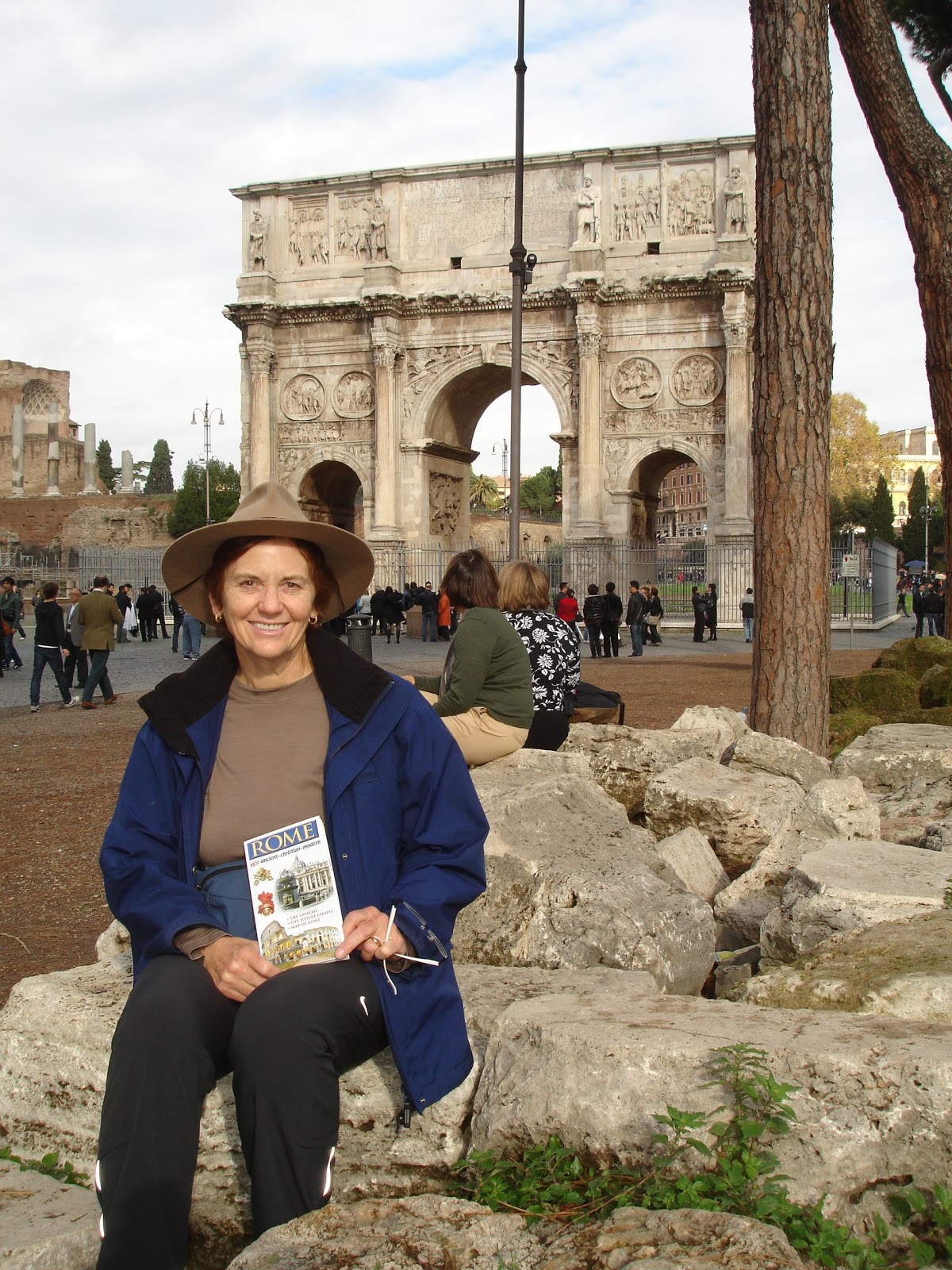
Wednesday, November 24, 2010
Living in Rome 21 - 23.11.10
21.11.10
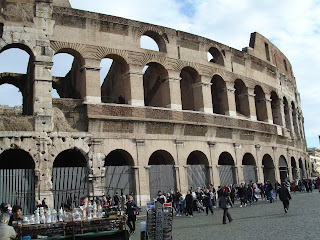
The last time we saw the Colisseum it still had gladiators racing around it. Well, not quite, but it was a really long time ago. Funny, it still looks just the same except that it now has squillions of tourists racing around it. We hadn’t thought to go early to get a ticket to get in, maybe there were not even tickets needed last time, but we decide to join a guided tour to avoid an hour’s wait in a queue. There’s not much for a guide to say about it really: it’s very very big, it held 80,000 people, they used to have all sorts of unpleasant sports in there, ending with the death of animals and people and they also used to fill the floor with water and have mock naval battles.
They did, however, provide it all free, along with food, to keep the populace happy. Considering how much money tourists pour into the Roman economy every year in hotels, restaurants, taxis, souvenirs, I reckon they should just let everyone in for free now.
It was our day to tick off the Colisseum, the Roman Forum, the Palatine Hill and the Circus Maximus on our must-see list, and they were all worth a look. The one that really got to us (and there were only about 6 tourists there) was the Circus Maximus because it was actually built by the Etruscans and held 350,000 spectators for the big Charlton Heston chariot racing events. 350,000 people! Huge!
Talking of big and free events, the city of Rome did actually turn on something both big and free yesterday. All of the museums in the city were open in the evening (and when I say all the museums, in Rome that means an incredible number) plus the university and lots of the palazzos, for free hour-long concerts. Every kind of music you could imagine: fancy a New Orleans jazz band? Go to the Accademia Belgica.. Some Flamenco? Try the Casa delle Letterature. Folk music? Spanish? Blues? Any kind of classical you could imagine? Something like 40 concerts at once. Dazzled by the choice we opt for baroque music with 2 sopranos and a bass, partly because it is close and partly because it is baroque music and is in the Museo Nationale Romano Crypta Balbi, which sounds interesting. When we get there, after wandering up and down the street for half an hour, we enter a museum that has no sign at all outside and is something really different. It is a history museum, certainly, but of one city block. A whole museum just for one block. That’s Rome for you, way too much history.
The musicians file in, we are all standing on the walkway above one of the exhibits, a few big chunks of pillars, and they start to do their thing. Pretty little madrigals float up to us, accompanied by a man playing those unlikely-looking old stringed instruments, lutes with long necks, or strangely bent. It was very entertaining, and when it finished we wandered around looking at the exhibits. Another bit of pottery, rusty spoons, that sort of thing. We don’t stay long, seen it all before.
22.11.10
So we’re sitting in the trattoria right next door to our apartment. (We are pretty well placed, a trattoria is next door and directly opposite is the internet café and a hairdresser). Anyway, the restaurant is full of people and the guitarist is wandering from table to table, singing all the usual suspects: Santa Lucia, Volare, O Sole Mio. Everyone is clapping, singing along, laughing.
Today is a big day. We saw Pompeii! Why is it so big (apart from Pompeii’s story, of course)? Because the last time we tried , in 1971, it was closed (of course!) But not today. We figured if we went with a group it would be sure to be open. Once bitten, twice shy, we won’t risk just rocking up again.
So we book into a bus tour for the day. This is very weird for us, we have never done it before, we always laugh at those groups of people wandering around tourist spots like little flocks of sheep, but here we are , at 7 am getting onto a coach to drive 3 hours for a quick look at Naples and a slightly longer look at Pompeii.
We eye off the other passengers as they get on. There is a plump boy from Brisbane with a big camera and a bag of sweets. There is a brisk grey-haired woman from Canada and a genial man from Brazil. A bunch of tubby middle-aged Portuguese women get on, it seems like 100 from the noise they make, but it’s really only 6. They talk without pausing for breath for the entire day. What can they possibly think of to say for so long? There are two petite little gals of no fixed age from the deep South in the USA, with identical face-lifts. Several querulous yanks complaining sotto voce about almost everything. And us, settled back to watch the world go by at 100 km an hour.

Mt Vesuvius across the Bay of Naples
How amazing is Pompeii! What a vivid sense of the city in full swing; the remains of the houses, still with mosaic floors and painted walls, giving a clear picture of comfortable middle-class life in 79 A.D.


The wine and oil shops, the bakery which still had 80 loaves of bread in the oven, the theatre with seating for 3,000 and the baths, both with inscriptions from the city councillors who paid for repairs after an earthquake. The message between the lines: we paid for this, vote for us. There is a lot of giggling and chuckling about the brothel with its little rooms with stone divans and built-in pillows, the explicit paintings still on the walls.
Then there are the extremely poignant figures, just a few are on display. One of the early archaeologists made plaster casts of some of the figures he found; the ash had covered them, and set, then the bodies and bones had disappeared leaving the shape. So these poor people are preserved in the moment of death, crouched down with their hands over their faces against the ash and cinders, or lying, felled as they ran. A dog twisted in its death throes. It is very moving. This was a bustling, thriving city of 25,000 people captured forever in one cataclysmic event.

23.11.10
So we’re sitting in the trattoria this evening. Sounds like last night doesn’t it! We’ve just ordered dinner and we are surrounded by people eating and chatting. Suddenly the whole place erupts in shrieks. We jump, startled. Then we realise that a football game is on the two little plasma screens. It’s Roma vs a Dutch team and a goal has made it 2:1 to the Dutch. There is utter drama in the restaurant. All the staff are glued to the screen along with most of the diners. Even the chef is leaning through the hatch between the kitchen and the dining room. The cashier is running his hands through his hair in despair.
We hope the chef will be able to cope. We need to eat, it’s been a big day. We did the Sistine Chapel. Well actually Michelangelo and his band of genius mates did the Sistine Chapel. But we gave it our best effort and, yes, it’s worth all the fuss. Every inch of every wall and the ceiling is covered with fabulous art. This is not unusual in Italy, there’s acres of it in every building in every city, but this is utterly stunning.

Panel in Sistine Chapel
Just to do the end wall behind the altar took Michelangelo 6 years. Of course, it’s a biggish sort of wall and he did 300 figures on it. Judgment Day, people rising from the grave, being swept up to the sky. Jesus on a cloud sending them either to heaven or, look at those poor devils (so to speak) down to hell.
And then the ceiling with the oh, so famous image of…sorry, another yell just went up, another goal, this time to Roma. The decibels reach pain level around us. Roma has won the game 3 to 2! Someone is thumping a table and shouting. The cashier looks exhausted and has tears in his eyes. Now , where was I? Oh yes, God breathing life into Adam, figures almost touching, in the middle of the ceiling. Panels all along the sides by the foremost painters of the day. All different, all fabulous. We looked and looked, went out, came back for another long gaze. I needed to check the faces on the Judgment Day wall again.
But there’s much more to the Vatican, so much that part of it is now called the Vatican Museum. Before tourism took off, who saw all this stuff? Just the Pope and his pals? Hundreds of rooms crammed with antiquities, artefacts, art.


The last time we saw the Colisseum it still had gladiators racing around it. Well, not quite, but it was a really long time ago. Funny, it still looks just the same except that it now has squillions of tourists racing around it. We hadn’t thought to go early to get a ticket to get in, maybe there were not even tickets needed last time, but we decide to join a guided tour to avoid an hour’s wait in a queue. There’s not much for a guide to say about it really: it’s very very big, it held 80,000 people, they used to have all sorts of unpleasant sports in there, ending with the death of animals and people and they also used to fill the floor with water and have mock naval battles.
They did, however, provide it all free, along with food, to keep the populace happy. Considering how much money tourists pour into the Roman economy every year in hotels, restaurants, taxis, souvenirs, I reckon they should just let everyone in for free now.
It was our day to tick off the Colisseum, the Roman Forum, the Palatine Hill and the Circus Maximus on our must-see list, and they were all worth a look. The one that really got to us (and there were only about 6 tourists there) was the Circus Maximus because it was actually built by the Etruscans and held 350,000 spectators for the big Charlton Heston chariot racing events. 350,000 people! Huge!
Talking of big and free events, the city of Rome did actually turn on something both big and free yesterday. All of the museums in the city were open in the evening (and when I say all the museums, in Rome that means an incredible number) plus the university and lots of the palazzos, for free hour-long concerts. Every kind of music you could imagine: fancy a New Orleans jazz band? Go to the Accademia Belgica.. Some Flamenco? Try the Casa delle Letterature. Folk music? Spanish? Blues? Any kind of classical you could imagine? Something like 40 concerts at once. Dazzled by the choice we opt for baroque music with 2 sopranos and a bass, partly because it is close and partly because it is baroque music and is in the Museo Nationale Romano Crypta Balbi, which sounds interesting. When we get there, after wandering up and down the street for half an hour, we enter a museum that has no sign at all outside and is something really different. It is a history museum, certainly, but of one city block. A whole museum just for one block. That’s Rome for you, way too much history.
The musicians file in, we are all standing on the walkway above one of the exhibits, a few big chunks of pillars, and they start to do their thing. Pretty little madrigals float up to us, accompanied by a man playing those unlikely-looking old stringed instruments, lutes with long necks, or strangely bent. It was very entertaining, and when it finished we wandered around looking at the exhibits. Another bit of pottery, rusty spoons, that sort of thing. We don’t stay long, seen it all before.
22.11.10
So we’re sitting in the trattoria right next door to our apartment. (We are pretty well placed, a trattoria is next door and directly opposite is the internet café and a hairdresser). Anyway, the restaurant is full of people and the guitarist is wandering from table to table, singing all the usual suspects: Santa Lucia, Volare, O Sole Mio. Everyone is clapping, singing along, laughing.
Today is a big day. We saw Pompeii! Why is it so big (apart from Pompeii’s story, of course)? Because the last time we tried , in 1971, it was closed (of course!) But not today. We figured if we went with a group it would be sure to be open. Once bitten, twice shy, we won’t risk just rocking up again.
So we book into a bus tour for the day. This is very weird for us, we have never done it before, we always laugh at those groups of people wandering around tourist spots like little flocks of sheep, but here we are , at 7 am getting onto a coach to drive 3 hours for a quick look at Naples and a slightly longer look at Pompeii.
We eye off the other passengers as they get on. There is a plump boy from Brisbane with a big camera and a bag of sweets. There is a brisk grey-haired woman from Canada and a genial man from Brazil. A bunch of tubby middle-aged Portuguese women get on, it seems like 100 from the noise they make, but it’s really only 6. They talk without pausing for breath for the entire day. What can they possibly think of to say for so long? There are two petite little gals of no fixed age from the deep South in the USA, with identical face-lifts. Several querulous yanks complaining sotto voce about almost everything. And us, settled back to watch the world go by at 100 km an hour.
Mt Vesuvius across the Bay of Naples
How amazing is Pompeii! What a vivid sense of the city in full swing; the remains of the houses, still with mosaic floors and painted walls, giving a clear picture of comfortable middle-class life in 79 A.D.

Beware of the Dog Mosaic

Then there are the extremely poignant figures, just a few are on display. One of the early archaeologists made plaster casts of some of the figures he found; the ash had covered them, and set, then the bodies and bones had disappeared leaving the shape. So these poor people are preserved in the moment of death, crouched down with their hands over their faces against the ash and cinders, or lying, felled as they ran. A dog twisted in its death throes. It is very moving. This was a bustling, thriving city of 25,000 people captured forever in one cataclysmic event.

23.11.10
So we’re sitting in the trattoria this evening. Sounds like last night doesn’t it! We’ve just ordered dinner and we are surrounded by people eating and chatting. Suddenly the whole place erupts in shrieks. We jump, startled. Then we realise that a football game is on the two little plasma screens. It’s Roma vs a Dutch team and a goal has made it 2:1 to the Dutch. There is utter drama in the restaurant. All the staff are glued to the screen along with most of the diners. Even the chef is leaning through the hatch between the kitchen and the dining room. The cashier is running his hands through his hair in despair.
We hope the chef will be able to cope. We need to eat, it’s been a big day. We did the Sistine Chapel. Well actually Michelangelo and his band of genius mates did the Sistine Chapel. But we gave it our best effort and, yes, it’s worth all the fuss. Every inch of every wall and the ceiling is covered with fabulous art. This is not unusual in Italy, there’s acres of it in every building in every city, but this is utterly stunning.

Panel in Sistine Chapel
Just to do the end wall behind the altar took Michelangelo 6 years. Of course, it’s a biggish sort of wall and he did 300 figures on it. Judgment Day, people rising from the grave, being swept up to the sky. Jesus on a cloud sending them either to heaven or, look at those poor devils (so to speak) down to hell.
And then the ceiling with the oh, so famous image of…sorry, another yell just went up, another goal, this time to Roma. The decibels reach pain level around us. Roma has won the game 3 to 2! Someone is thumping a table and shouting. The cashier looks exhausted and has tears in his eyes. Now , where was I? Oh yes, God breathing life into Adam, figures almost touching, in the middle of the ceiling. Panels all along the sides by the foremost painters of the day. All different, all fabulous. We looked and looked, went out, came back for another long gaze. I needed to check the faces on the Judgment Day wall again.
But there’s much more to the Vatican, so much that part of it is now called the Vatican Museum. Before tourism took off, who saw all this stuff? Just the Pope and his pals? Hundreds of rooms crammed with antiquities, artefacts, art.

Section of Fresco in Rafael Room
And every wall, every ceiling, every pillar and post painted by painters famous for their brilliance. It’s dazzling, stunning, overwhelming. What is not any of these are the 54 rooms of modern religious art, which is unremittingly ugly and it is irritating to have to walk past it after being immersed in such extremes of beauty. What were they thinking to hang this stuff on the wall? We get through that, look for the one thing we haven’t yet managed to connect with anywhere, the Etruscan exhibits, but that section is closed (of course!). We have a coffee and walk home along the river, heads reeling.
Tuesday, November 23, 2010
In Rome 20.11.10
20.11.10 In Rome

Next morning we front up at St Peter’s again, bright and early, to get our gold star. We say the priest’s name, Don Bruno Vercessi, and are directed through to the Sacristy, past the Swiss guards in their gaudy mediaeval uniforms and into a little office.
After a long wait (I don’t think anyone hurries in the Vatican from what I have observed already of the cardinals walking steadily and calmly across the square with a red skull cap and a briefcase) we are issued with a visitor pass. This is the magic I.D. that, along with Don Bruno’s name seems to open every door. We are waved through, barriers are shifted to let us pass, doors are opened. As we walk across from the office, we are challenged several times, but just to point to the pass clipped to our shirts fixes that.
We are ushered into a hallway where an elderly monk is waiting for us. He welcomes us genially, warmly, slowly. We sit at a table while he chats, asks us about our journey, inspects every stamp in our credencial. No hurry, all the time in the world. He brings out the book and very slowly fills in our details and invites us to write a comment about our pilgrimage.

He then invites us to come back after midday and he will take us down to St Peter’s Chapel, down below the church. Hey, private tour of somewhere special, why not? We come back, as requested, the staff are all saying midday prayers and we can’t get through the corridor, but Catholic prayers don’t take long and we walk through to wait for the Don. He appears again and leads us through the back corridors and down into the depths. There are strings of little chapels covered in old frescoes. Finally we reach our destination.
It is very fancy, lots of gold, very grand but on a small scale, only about 2 metres wide and about 5 long. .

We admire it appropriately while the don stand by, beaming. It seems very important to him to tell that a bit of early Greek graffiti was found on the old original wall “Peter was here.” That confounds those pesky Protestants who say that Peter never went to Rome.
After we have spent a bit of time here, Don Bruno sits us down, says the Lord’s Prayer and launches into a little sermon. He is so sincere, if perhaps a tiny bit, um, elderly.
Then he focuses on me and moves onto St Peter on the role of women in marriage, quotes the bit about how wives should be submissive. He looks expectantly at me. It is all I can do to restrain myself, but what’s the point of making a fuss, after all we are sitting deep in the building at the heart of the Catholic church. Anyway, we might not be able to find our way out. But I imagine St Peter at the pearly gates saying to Don Bruno, “You were very conscientious, most of what you did was good, but that stuff you used to go on about wives and submission, that was bit off.” “But it was in your Epistle.” “Mate, what I wrote was all ahead of its time, but you were 2000 years later, you needed to update a bit.”
The Don finally lays his hand on our heads and blesses us and we escape. But it was a rare opportunity to go somewhere in the cathedral where tourists can’t go and see the workings behind the scenes. There’s no such thing as a free lunch.
We give back our passes, head out and turn into tourists. We have decided to just live in Rome for a week, so we move to a serviced apartment and settle in. Buy some food, relax, nurse our feet, leisurely explore the ruins. About those ruins, why would you have stuff in museums when you trip over bits of it every two steps around Rome? But we start doing the rounds, in a laid back, we live in Rome sort of way.
The weather, of course, continues to be very unpredictable. Or, rather, you can predict that it will rain and then change to blue skies every hour. Since Bolsena we have coined a new term for torrential downpours. We look out the window and say to each other, better put on the waterproofs, it Bolsena-ing.
And because it is Bolsena-ing in a big way, we go to do an inside thing, visit the Palazzo Barberini. Now, I don’t know how the early Pope’s got elected, but they all seem to have come from the very wealthy families, and there was a Barberini Pope who, like so many of them, fostered artists and sculptors and lived in fabulous palaces. The Barberini shack is stunning, with a staircase to make your knees go weak (and not from the number of stairs). Want a nice staircase, with some excellent use of light and sculpture and the lines and angles a picture in themselves? Call in Bernini, and while he’s at it, get him to knock up a couple of fountains on the street corners near the house.
I won’t bore you with reciting all of the fabulous artists whose paintings are in the Palazzo Barberini, but my personal favourite was a portrait by Rafael of his girlfriend, the baker’s daughter with the cheeky smile, La Fornarina.
In the evening we go to a concert of favourite opera arias, in the American Episcopal church. We sit in the front row. I could not possibly have imagined what would happen at the end. Lovely singing etc etc, then suddenly one of the tenors darts over pulls me out of my seat and waltzes me around in front of 1000 people. My only fear was that I would tread on his dainty toes with my, yes, my clodhopper walking boots. Phew, managed not to. Then when they took their applause, he got me up to take a bow with them, kissed my hand and took me to my seat. I loved it!


Next morning we front up at St Peter’s again, bright and early, to get our gold star. We say the priest’s name, Don Bruno Vercessi, and are directed through to the Sacristy, past the Swiss guards in their gaudy mediaeval uniforms and into a little office.
After a long wait (I don’t think anyone hurries in the Vatican from what I have observed already of the cardinals walking steadily and calmly across the square with a red skull cap and a briefcase) we are issued with a visitor pass. This is the magic I.D. that, along with Don Bruno’s name seems to open every door. We are waved through, barriers are shifted to let us pass, doors are opened. As we walk across from the office, we are challenged several times, but just to point to the pass clipped to our shirts fixes that.
We are ushered into a hallway where an elderly monk is waiting for us. He welcomes us genially, warmly, slowly. We sit at a table while he chats, asks us about our journey, inspects every stamp in our credencial. No hurry, all the time in the world. He brings out the book and very slowly fills in our details and invites us to write a comment about our pilgrimage.

He then invites us to come back after midday and he will take us down to St Peter’s Chapel, down below the church. Hey, private tour of somewhere special, why not? We come back, as requested, the staff are all saying midday prayers and we can’t get through the corridor, but Catholic prayers don’t take long and we walk through to wait for the Don. He appears again and leads us through the back corridors and down into the depths. There are strings of little chapels covered in old frescoes. Finally we reach our destination.
It is very fancy, lots of gold, very grand but on a small scale, only about 2 metres wide and about 5 long. .

We admire it appropriately while the don stand by, beaming. It seems very important to him to tell that a bit of early Greek graffiti was found on the old original wall “Peter was here.” That confounds those pesky Protestants who say that Peter never went to Rome.
After we have spent a bit of time here, Don Bruno sits us down, says the Lord’s Prayer and launches into a little sermon. He is so sincere, if perhaps a tiny bit, um, elderly.
Then he focuses on me and moves onto St Peter on the role of women in marriage, quotes the bit about how wives should be submissive. He looks expectantly at me. It is all I can do to restrain myself, but what’s the point of making a fuss, after all we are sitting deep in the building at the heart of the Catholic church. Anyway, we might not be able to find our way out. But I imagine St Peter at the pearly gates saying to Don Bruno, “You were very conscientious, most of what you did was good, but that stuff you used to go on about wives and submission, that was bit off.” “But it was in your Epistle.” “Mate, what I wrote was all ahead of its time, but you were 2000 years later, you needed to update a bit.”
The Don finally lays his hand on our heads and blesses us and we escape. But it was a rare opportunity to go somewhere in the cathedral where tourists can’t go and see the workings behind the scenes. There’s no such thing as a free lunch.
We give back our passes, head out and turn into tourists. We have decided to just live in Rome for a week, so we move to a serviced apartment and settle in. Buy some food, relax, nurse our feet, leisurely explore the ruins. About those ruins, why would you have stuff in museums when you trip over bits of it every two steps around Rome? But we start doing the rounds, in a laid back, we live in Rome sort of way.
The weather, of course, continues to be very unpredictable. Or, rather, you can predict that it will rain and then change to blue skies every hour. Since Bolsena we have coined a new term for torrential downpours. We look out the window and say to each other, better put on the waterproofs, it Bolsena-ing.
And because it is Bolsena-ing in a big way, we go to do an inside thing, visit the Palazzo Barberini. Now, I don’t know how the early Pope’s got elected, but they all seem to have come from the very wealthy families, and there was a Barberini Pope who, like so many of them, fostered artists and sculptors and lived in fabulous palaces. The Barberini shack is stunning, with a staircase to make your knees go weak (and not from the number of stairs). Want a nice staircase, with some excellent use of light and sculpture and the lines and angles a picture in themselves? Call in Bernini, and while he’s at it, get him to knock up a couple of fountains on the street corners near the house.
I won’t bore you with reciting all of the fabulous artists whose paintings are in the Palazzo Barberini, but my personal favourite was a portrait by Rafael of his girlfriend, the baker’s daughter with the cheeky smile, La Fornarina.

Sunday, November 21, 2010
La Storta to Rome 17.11.10
17.11.10 La Storta to Rome
 Triumphant entry to Rome!
At breakfast at the convent there is another guest, a shy and very pale faced boy who could have stepped off the page of any mediaeval bible; get him into a brown cassock with a rope around his waist, re-style his hair with a tonsure and put a little edge of vine leaves and he’s that monk making the first letter on the page.
We step out of the oasis of the convent garden and onto the road. Bam, it’s peak hour, trucks and cars everywhere. People lined up waiting for buses to go to work. Real life is rather shocking, we’re not used to it.
But there’s nothing for it but to walk that horrid stretch of road. Nothing is going to stop us walking into St Peter’s. We stride out, let’s get it done. I‘m still lame, hobbling along, or I would be if my pride let me, and I would crawl there on hands and knees rather than resort to a bus for the final moment of the journey.
We stop for a coffee and an old man with a snappy, yappy dog at the next table stares and stares. Then he says, “Just 10 km to go”. We are pretty practiced now at the humble but proud look and say our little piece, that we are “pellegrini Australiani, a piedi de la Francia a Roma”. We have said it so many times now, and it always gets a great reaction. He beams, “Complimenti! Complimenti!”
We walk down the Via Cassia, I wonder who Cassia was, I must check her out, we have such a long relationship with her now. There is a minor road, the Cassia Vecchia, that looks a little bit longer but we take it and immediately it is quieter, more residential, with gardens.
We stop to buy some bread rolls when we find a shop near the city and suddenly see gypsies again. They are in all the big tourist towns and we haven’t seen them since Siena. The young girls look like proper storybook gypsies with long swaying skirts and long plaits. They are begging or scamming. The old women have scarves and coats and kneel motionless on the footpath with a hand out, holding a plastic cup with a coin in it. They are all filthy. Where are they from? Is it Albania or Romania, and is this the only life for them? It is very disturbing and unsettling. We are out of the quiet country life and into a big city again.
But ahead of us is the river, and when we reach it we turn to walk along it towards the Vatican. There is a quiet walkway and cycleway along the water’s edge; it is a much nicer entry to Rome than we had expected.
We are walking slowly along, taking our time, looking all around. Suddenly in the distance the dome of St Peter’s shows on the skyline.
There is a long road leading straight to our destination. We walk under an arch and we are in St Peter’s Square.
It is magnificent, huge. It is also filled with grey plastic chairs and barricades and thronged with people. Apparently the Pope had an audience today and it sure draws a crowd. We go to find the Sacristy where we can get our Testimonium, the certificate that is issued to pilgrims who have the credencial, the little document stamped every day along the way, evidence of having done the pilgrimage.
First we have to go through security check, after a long wait in line we go through. Into St Peter’s, gasp, amazing building, but we are focussed on our certificates. But the monk who issues them is finished for the day (of course!) and won’t be back till 9 tomorrow.
The official on the door goes away and checks, but he confirms that it’s not possible today. But he keeps looking at us, and then he says, “I saw you, on the road, twice, once at Viterbo and once at Monterosi.” He keeps saying “capella” – hat, and miming striding along with trekking poles. He must have noticed our Akubras as we walked along the road. We are pretty surprised by this coincidence, here he is on the door of the Sacristy office in St Peter’s . No testimonium happening here today, though, so we turn and leave.
I refuse to look at anything in St Peter’s until we have found our hotel and got our backpacks off, so we head straight out again. We see the other place where it is possible to get the testimonium, issued by the city, so we go there and, without any fuss, there it is, nicely stamped and signed. We set off for the hotel.
Rome is so, so cool! We are not. We walk along the streets leading to the hotel past people dressed beautifully; the jackets, the boots, the handbags, the hair, all ultra elegant and cosmopolitan. “I wish I wasn’t carrying my backpack, “ I say. “It’s gonna take more than that,” he replies. How true.
We are like little kids at a grown-up party looking at the shops as we walk, there is Gucci and Pucci, there is Fendi, Ferragamo and Furla. Streets and streets of it, everywhere we look there is another top-end boutique crammed with dazzling things.
For two months now we have lived so simply, away from even the most basic necessities more often than not. We have saved a serviette from the table to mop our brow as we walk, put a couple of slices of bread and cheese in our pocket at breakfast because it might be all we can get during the day, fill an empty coke bottle with leftover wine at dinner to take with us in the backpack. What to do without? Everything, pretty much. What little luxuries? A book. What’s for lunch? A bread roll, an apple. And every night the rituals: I wash the socks and if there is a big enough heater, a shirt as well. We unpack our few belongings, R puts the phone, the GPS and the camera on to charge. We walk out to see the exit from town the next morning. It’s such a simple life.
 Now we are here and we will ease back into reality. But we made it! We walked, one step at a time, and we're here.

At breakfast at the convent there is another guest, a shy and very pale faced boy who could have stepped off the page of any mediaeval bible; get him into a brown cassock with a rope around his waist, re-style his hair with a tonsure and put a little edge of vine leaves and he’s that monk making the first letter on the page.
We step out of the oasis of the convent garden and onto the road. Bam, it’s peak hour, trucks and cars everywhere. People lined up waiting for buses to go to work. Real life is rather shocking, we’re not used to it.
But there’s nothing for it but to walk that horrid stretch of road. Nothing is going to stop us walking into St Peter’s. We stride out, let’s get it done. I‘m still lame, hobbling along, or I would be if my pride let me, and I would crawl there on hands and knees rather than resort to a bus for the final moment of the journey.
We stop for a coffee and an old man with a snappy, yappy dog at the next table stares and stares. Then he says, “Just 10 km to go”. We are pretty practiced now at the humble but proud look and say our little piece, that we are “pellegrini Australiani, a piedi de la Francia a Roma”. We have said it so many times now, and it always gets a great reaction. He beams, “Complimenti! Complimenti!”
We walk down the Via Cassia, I wonder who Cassia was, I must check her out, we have such a long relationship with her now. There is a minor road, the Cassia Vecchia, that looks a little bit longer but we take it and immediately it is quieter, more residential, with gardens.
We stop to buy some bread rolls when we find a shop near the city and suddenly see gypsies again. They are in all the big tourist towns and we haven’t seen them since Siena. The young girls look like proper storybook gypsies with long swaying skirts and long plaits. They are begging or scamming. The old women have scarves and coats and kneel motionless on the footpath with a hand out, holding a plastic cup with a coin in it. They are all filthy. Where are they from? Is it Albania or Romania, and is this the only life for them? It is very disturbing and unsettling. We are out of the quiet country life and into a big city again.
But ahead of us is the river, and when we reach it we turn to walk along it towards the Vatican. There is a quiet walkway and cycleway along the water’s edge; it is a much nicer entry to Rome than we had expected.
We are walking slowly along, taking our time, looking all around. Suddenly in the distance the dome of St Peter’s shows on the skyline.
There is a long road leading straight to our destination. We walk under an arch and we are in St Peter’s Square.
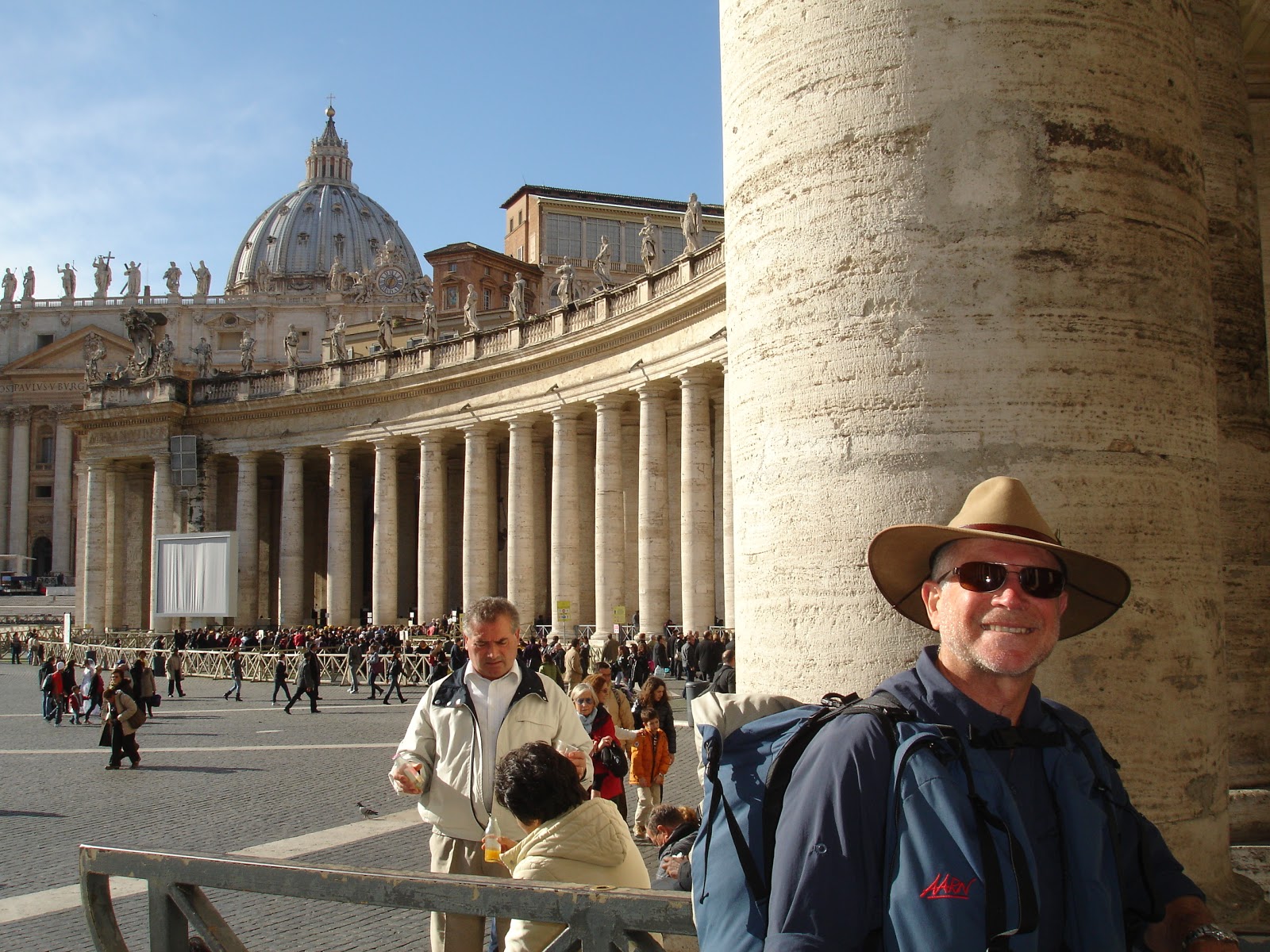
It is magnificent, huge. It is also filled with grey plastic chairs and barricades and thronged with people. Apparently the Pope had an audience today and it sure draws a crowd. We go to find the Sacristy where we can get our Testimonium, the certificate that is issued to pilgrims who have the credencial, the little document stamped every day along the way, evidence of having done the pilgrimage.
First we have to go through security check, after a long wait in line we go through. Into St Peter’s, gasp, amazing building, but we are focussed on our certificates. But the monk who issues them is finished for the day (of course!) and won’t be back till 9 tomorrow.
The official on the door goes away and checks, but he confirms that it’s not possible today. But he keeps looking at us, and then he says, “I saw you, on the road, twice, once at Viterbo and once at Monterosi.” He keeps saying “capella” – hat, and miming striding along with trekking poles. He must have noticed our Akubras as we walked along the road. We are pretty surprised by this coincidence, here he is on the door of the Sacristy office in St Peter’s . No testimonium happening here today, though, so we turn and leave.
I refuse to look at anything in St Peter’s until we have found our hotel and got our backpacks off, so we head straight out again. We see the other place where it is possible to get the testimonium, issued by the city, so we go there and, without any fuss, there it is, nicely stamped and signed. We set off for the hotel.
Rome is so, so cool! We are not. We walk along the streets leading to the hotel past people dressed beautifully; the jackets, the boots, the handbags, the hair, all ultra elegant and cosmopolitan. “I wish I wasn’t carrying my backpack, “ I say. “It’s gonna take more than that,” he replies. How true.
We are like little kids at a grown-up party looking at the shops as we walk, there is Gucci and Pucci, there is Fendi, Ferragamo and Furla. Streets and streets of it, everywhere we look there is another top-end boutique crammed with dazzling things.
For two months now we have lived so simply, away from even the most basic necessities more often than not. We have saved a serviette from the table to mop our brow as we walk, put a couple of slices of bread and cheese in our pocket at breakfast because it might be all we can get during the day, fill an empty coke bottle with leftover wine at dinner to take with us in the backpack. What to do without? Everything, pretty much. What little luxuries? A book. What’s for lunch? A bread roll, an apple. And every night the rituals: I wash the socks and if there is a big enough heater, a shirt as well. We unpack our few belongings, R puts the phone, the GPS and the camera on to charge. We walk out to see the exit from town the next morning. It’s such a simple life.

Saturday, November 20, 2010
Capranica to Campagnana de Roma 15.11.10
15.11.10 Capranica to Campagnana de Roma

I had warned R that leaving Capranica would be a photofest. The hard harsh history of the daily life of Italy away from the big cities is clearly laid out. The poverty, the crowding, the daily drudgery and tedium of living in these mean streets.
More recently so many towns in Italy took a hammering during the second world war, and there was no work, no hope, hunger and despair. No wonder so many people took the chance to emigrate to somewhere offering more opportunity in life. Even now I think about the teenagers and young adults I see, nothing to do, silent streets. Is it different to life for kids in Australia in the suburbs? Maybe not, but it seems very dreary, little knots of them sitting in the cold outside the pizzeria, the café.
We strike out for Monterosi, straight up a long hill. Suddenly R realises he doesn’t have the guidebook. It must have fallen out of his pocket. He runs back down the hill, finds it and comes back up. We have form in this – in Spain we were climbing a long hill early on, before we were fit, and I saw a sunglasses lens on the ground. “Some poor bloke has lost that, “I thought, as I stepped delicately over it. At the top of the hill R says, “Oh no, I’ve lost a lens.” I realise what has happened and tell him. He sighs and runs back down to get it. Same today. So far, so good, but it comes back to haunt us later.
Nice scenery, threatening weather, contradictory Via signs. We plod on. 5km out is Sutri, on a strategic spot at the confluence of two rivers. It was an Etruscan stronghold, then Roman, then Christian. There is a Roman amphitheatre. I stand and think about the poor bastards waiting in the wings to be sent out to fight a lion. There is only one ending to that story, for the gladiator.

Roman amphitheatre at Sutri
The site also has an Etruscan necropolis, tombs cut into the volcanic rock cliff. How old is that ? What were their lives like? About the same as ours, probably, eat. Sleep, work, raise families.
We reach Monterosi, our destination. There is only one lead for a place to stay. We can’t find it, but – here’s the funny part – neither can any of the locals we ask. Not a clue where the hotel is, the street is, no idea. One person suggests we could walk a couple of km and see if we find it. I look down the road. 2 km is out into the countryside, great suggestion. It’s a drab little town anyway. I pull the pin, find out when the bus goes to Campagnana de Roma and, an hour later, here we are.
But the guidebook, determined to escape, must have fallen out of R’s pocket as we got out of the bus and it is now on its way to Rome. We stand on the footpath absorbing the thought. I am quietly confident that I will be nominated for the Nobel Peace Prize for not saying anything at that moment. Fortunately there are only two days to Rome, so we will find a way. How to go cross country without a map? We head for the place we want to stay, discover it is 4 km away and stop for help at a tourist office that appears magically in our path.
A helpful Signora gives us a map, writes a list of turns to get onto the off-road Via route and finds a hotel in town for us. I feel like leaping over the counter to throw my arms around her.
We find the hotel, musing on this life question and we drag up several flights of stairs: why is it that the nmore tired you are the higher your room is? The view is nice, of course, as long as you don’t give up on the last landing and just lie down and die. We settle in, head down for dinner in the little restaurant. It’s just us. The pardon sits stolidly in the corner watching the television, turned up loud to the inevitable game show, while we eat. I wouldn’t want to open up for just us either. In the book I read about the couple who went to live in Tuscany I read about feasts for lunch, five courses, that go on till the last person falls unconscious. That sounds like fun, but it’s not the meals we are having. Firstly we upset the proper order of things, we want my soup, his meat, my salad, all at once. And we order so little, one course each, two at most, once in a blue moon a sweet. What’s the point of having a restaurant if you have customers like us?
In 2 days we will walk into St Peter’s.
16.11.2010 Campagnano de Roma to La Storta
Those Romans sure worked hard! They ruled Western Europe and, trust me, it’s a long way from end to end when it’s all done on foot. The administration, money, power, bureaucracy is incredible to consider. They built monuments, temples, aqueducts. But the most amazing thing is those roads. You bump into them all over the place in the old Roman Empire, no matter how remote. Straight as an arrow, flat and firm. You’ll be walking along a straight path and you’ll look down and there it will be. Lots of them have been quarried for building, but astounding stretches are still there, 2500 years later. Cars drive on them!
The Romans used massive amounts of effort, three layers of carefully prepared road bed, then smooth stones trimmed and fitted together to form that flat surface. Originally they were edged with a rim of stones with a gravel track down the side for horses. It is awe-inspiring to walk on them and I had a Sigeric moment too, one day, knowing that my feet were definitely treading the exact surfaces he did, 1000 years ago.

We follow the Signora’s instructions in the morning and it gets us out of town, then a car pulls up in the middle of the road and a man directs us 50 metres up the road, where we find the track. All day I am thinking that this might be the last forest walk, the last soft path. It’s raining on and off, but the mist is pretty and the track is very picturesque.
 We follow the map and the Via signs all day and it finally drops us off out of the forest and onto a busy crossroads. The next Via arrow is ambiguous and the map is useless. WE try one way, then the other. No more signs. Lots of traffic. The noise is shocking after the silence of the forest paths. WE ask at the service station. “No idea”. We go onto the most obvious road then back off – it’s way too dangerous, no footpath and huge trucks flying through. I say something, R stops, I stumble and bump into him and half fall over. You can see where this is leading. What follows is a brief but insightful discussion of each others’ personality and character.
We walk off in two different directions then circle back and sit down on a bench at the service station to draw up the peace agreement. It’s Yalta all over again except that we can’t divvy up any territories, not having any to start with, and currently carrying everything we own on our backs.
I take the map and decide to try another tack. Maybe one of these stupid (we really need the aid of German here, dumkopf is such a useful word) attendants can at least tell us exactly where we are on the map. I approach one, noticing, not for the first time, that servos here seem to be run by Indians, the same as in Australia. The guy point, “Ask him, he speaks good English.” I look over and see a young Italian bloke on the phone servicing a vending machine.
I wait, he smiles, finishes his conversation. Yes, he speaks good English, his mother is South African. It’s only a couple of km from our destination but he doesn’t know how to find the Via. We look at that scary road again. R says Is there a taxi? “I will drive you if you like,” he says. We give it a nanosecond’s thought. “Yes!”
We pile into Mario’s little car and he drives us to La Storta. It’s no distance, but he then helps us find somewhere to stay. We have an address for a convent and a hotel. We find the convent and go in. Mario comes in with us, arranges with the two sisters standing in the foyer with the two very smartly dressed lay ladies who are the day and evening cooks.
Mario is laughing, talking, smiling. He charms the socks off the nuns, well their HomyPeds anyway. Then he kisses me and R on both cheeks, holds the nuns hands in his, has a group photo taken, and breezes out. Everyone is smiling.
We have had some wonderful moments where people’s unexpected kindness has made a big difference and this was one of them. We won’t forget Mario.
 The nuns are lovely too. Little cheery sisters, all in white. “My sister lives in Blacktown!” Everyone loves Australia. Ah Bella Bella! Their eyes light up. Sidenee! It is a delightful thing to come from such a popular country. People almost clap their hands with admiration. Young people talk of coming, how to get there, how to get work. Their yearning to visit, to emigrate, is palpable. I fell as if I have won something, somehow almost unfairly, being born there, so easy. Then I remember how my ancestors braved danger and distance to make this happen. 100 years ago Lord Baden Powell said “Just by being British you have already won the lottery of life.” Of course that was when the Empire was still in full swing and Britain ruled half the world. Now it is my turn to feel lucky. Lucky to live in a country not powerful or influential in world affairs but just so good at everything, so fair and so clever.
OK that’s The Philosophy Hour over.
Our room has two little twin beds opening on to a balcony overlooking a garden. Elderly Italian sisters wander slowly along the paths, leaning on their canes. Brisk dark skinned nuns dart energetically along. Clearly the next generation of the church comes from Africa and India.
We walk down the road on our ongoing quest for the way on to the Via tomorrow. We stop for a coffee and the Romanian barman calls in a distinguished looking man to help us. His English is perfect, he is the professor of Horticulture at Viterbo University. But you are French Monsieur I exclaim as his English has a French accent. Ah no, I’m Italian but I am from Milan in the North so I sound French. He tells us that there is no off road Via anymore, it is all busy roads to Rome. 15 km to go.

I had warned R that leaving Capranica would be a photofest. The hard harsh history of the daily life of Italy away from the big cities is clearly laid out. The poverty, the crowding, the daily drudgery and tedium of living in these mean streets.
More recently so many towns in Italy took a hammering during the second world war, and there was no work, no hope, hunger and despair. No wonder so many people took the chance to emigrate to somewhere offering more opportunity in life. Even now I think about the teenagers and young adults I see, nothing to do, silent streets. Is it different to life for kids in Australia in the suburbs? Maybe not, but it seems very dreary, little knots of them sitting in the cold outside the pizzeria, the café.
We strike out for Monterosi, straight up a long hill. Suddenly R realises he doesn’t have the guidebook. It must have fallen out of his pocket. He runs back down the hill, finds it and comes back up. We have form in this – in Spain we were climbing a long hill early on, before we were fit, and I saw a sunglasses lens on the ground. “Some poor bloke has lost that, “I thought, as I stepped delicately over it. At the top of the hill R says, “Oh no, I’ve lost a lens.” I realise what has happened and tell him. He sighs and runs back down to get it. Same today. So far, so good, but it comes back to haunt us later.
Nice scenery, threatening weather, contradictory Via signs. We plod on. 5km out is Sutri, on a strategic spot at the confluence of two rivers. It was an Etruscan stronghold, then Roman, then Christian. There is a Roman amphitheatre. I stand and think about the poor bastards waiting in the wings to be sent out to fight a lion. There is only one ending to that story, for the gladiator.

Roman amphitheatre at Sutri
The site also has an Etruscan necropolis, tombs cut into the volcanic rock cliff. How old is that ? What were their lives like? About the same as ours, probably, eat. Sleep, work, raise families.
We reach Monterosi, our destination. There is only one lead for a place to stay. We can’t find it, but – here’s the funny part – neither can any of the locals we ask. Not a clue where the hotel is, the street is, no idea. One person suggests we could walk a couple of km and see if we find it. I look down the road. 2 km is out into the countryside, great suggestion. It’s a drab little town anyway. I pull the pin, find out when the bus goes to Campagnana de Roma and, an hour later, here we are.
But the guidebook, determined to escape, must have fallen out of R’s pocket as we got out of the bus and it is now on its way to Rome. We stand on the footpath absorbing the thought. I am quietly confident that I will be nominated for the Nobel Peace Prize for not saying anything at that moment. Fortunately there are only two days to Rome, so we will find a way. How to go cross country without a map? We head for the place we want to stay, discover it is 4 km away and stop for help at a tourist office that appears magically in our path.
A helpful Signora gives us a map, writes a list of turns to get onto the off-road Via route and finds a hotel in town for us. I feel like leaping over the counter to throw my arms around her.
We find the hotel, musing on this life question and we drag up several flights of stairs: why is it that the nmore tired you are the higher your room is? The view is nice, of course, as long as you don’t give up on the last landing and just lie down and die. We settle in, head down for dinner in the little restaurant. It’s just us. The pardon sits stolidly in the corner watching the television, turned up loud to the inevitable game show, while we eat. I wouldn’t want to open up for just us either. In the book I read about the couple who went to live in Tuscany I read about feasts for lunch, five courses, that go on till the last person falls unconscious. That sounds like fun, but it’s not the meals we are having. Firstly we upset the proper order of things, we want my soup, his meat, my salad, all at once. And we order so little, one course each, two at most, once in a blue moon a sweet. What’s the point of having a restaurant if you have customers like us?
In 2 days we will walk into St Peter’s.
16.11.2010 Campagnano de Roma to La Storta
Those Romans sure worked hard! They ruled Western Europe and, trust me, it’s a long way from end to end when it’s all done on foot. The administration, money, power, bureaucracy is incredible to consider. They built monuments, temples, aqueducts. But the most amazing thing is those roads. You bump into them all over the place in the old Roman Empire, no matter how remote. Straight as an arrow, flat and firm. You’ll be walking along a straight path and you’ll look down and there it will be. Lots of them have been quarried for building, but astounding stretches are still there, 2500 years later. Cars drive on them!
The Romans used massive amounts of effort, three layers of carefully prepared road bed, then smooth stones trimmed and fitted together to form that flat surface. Originally they were edged with a rim of stones with a gravel track down the side for horses. It is awe-inspiring to walk on them and I had a Sigeric moment too, one day, knowing that my feet were definitely treading the exact surfaces he did, 1000 years ago.

We follow the Signora’s instructions in the morning and it gets us out of town, then a car pulls up in the middle of the road and a man directs us 50 metres up the road, where we find the track. All day I am thinking that this might be the last forest walk, the last soft path. It’s raining on and off, but the mist is pretty and the track is very picturesque.

We walk off in two different directions then circle back and sit down on a bench at the service station to draw up the peace agreement. It’s Yalta all over again except that we can’t divvy up any territories, not having any to start with, and currently carrying everything we own on our backs.
I take the map and decide to try another tack. Maybe one of these stupid (we really need the aid of German here, dumkopf is such a useful word) attendants can at least tell us exactly where we are on the map. I approach one, noticing, not for the first time, that servos here seem to be run by Indians, the same as in Australia. The guy point, “Ask him, he speaks good English.” I look over and see a young Italian bloke on the phone servicing a vending machine.
I wait, he smiles, finishes his conversation. Yes, he speaks good English, his mother is South African. It’s only a couple of km from our destination but he doesn’t know how to find the Via. We look at that scary road again. R says Is there a taxi? “I will drive you if you like,” he says. We give it a nanosecond’s thought. “Yes!”
We pile into Mario’s little car and he drives us to La Storta. It’s no distance, but he then helps us find somewhere to stay. We have an address for a convent and a hotel. We find the convent and go in. Mario comes in with us, arranges with the two sisters standing in the foyer with the two very smartly dressed lay ladies who are the day and evening cooks.
Mario is laughing, talking, smiling. He charms the socks off the nuns, well their HomyPeds anyway. Then he kisses me and R on both cheeks, holds the nuns hands in his, has a group photo taken, and breezes out. Everyone is smiling.
We have had some wonderful moments where people’s unexpected kindness has made a big difference and this was one of them. We won’t forget Mario.

OK that’s The Philosophy Hour over.
Our room has two little twin beds opening on to a balcony overlooking a garden. Elderly Italian sisters wander slowly along the paths, leaning on their canes. Brisk dark skinned nuns dart energetically along. Clearly the next generation of the church comes from Africa and India.
We walk down the road on our ongoing quest for the way on to the Via tomorrow. We stop for a coffee and the Romanian barman calls in a distinguished looking man to help us. His English is perfect, he is the professor of Horticulture at Viterbo University. But you are French Monsieur I exclaim as his English has a French accent. Ah no, I’m Italian but I am from Milan in the North so I sound French. He tells us that there is no off road Via anymore, it is all busy roads to Rome. 15 km to go.
Subscribe to:
Posts (Atom)